VESTA EXPERIENCES
A Forest That Breathes: The Monarch Butterfly Migration
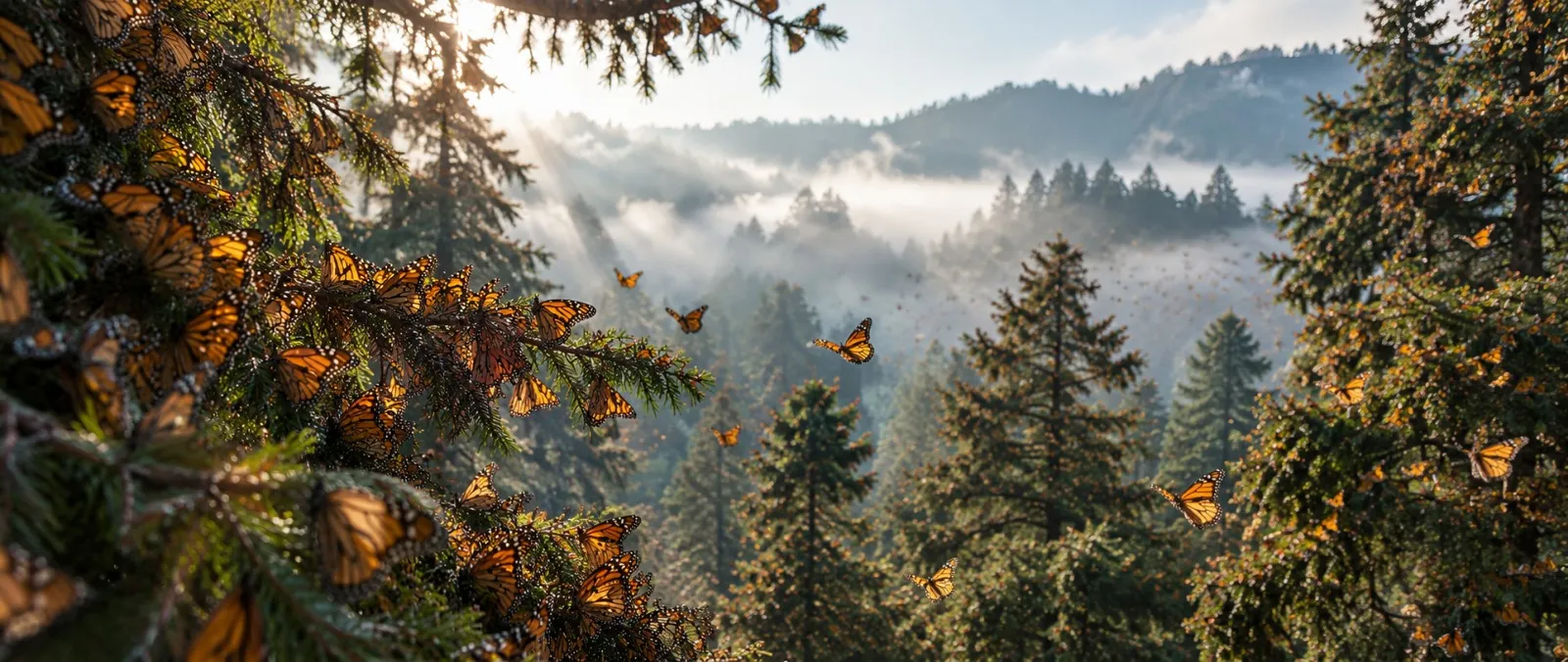
Every winter, one of nature's most improbable spectacles unfolds. Millions of monarch butterflies fly thousands of kilometers from Canada and the United States to a handful of fir forests in Michoacán and the State of Mexico, and cluster so densely that branches bend and the air fills with a beating of wings you can hear. It's no metaphor: the forest, literally, seems to breathe.
The most astonishing part is that none of these butterflies has made the journey before. The generation that reaches Mexico is a special one, it lives up to eight months, against the few weeks of the others, and returns by pure instinct to the very forest where its great-grandparents wintered, thousands of kilometers from where it was born. They arrive at a place they've never seen, guided by something science still can't fully explain.
The sanctuaries open around November and receive visitors through March. Seeing it takes some effort, a hike at altitude, in silence, early in the morning, when the sun wakes the butterflies, and that's exactly why it remains an uncrowded experience, the kind today's travelers who avoid the masses are seeking. It isn't only watching: it's stepping quietly into a misty forest, feeling the mountain cold, and then, as the sun warms, seeing thousands of butterflies release from the branches at once and fill the sky with orange.
Not all sanctuaries are alike
El Rosario is the most famous, with the greatest concentration of butterflies, more services and the busiest trail. Sierra Chincua is quieter, with a gentler path; both are near Morelia. For those flying via Toluca, Piedra Herrada, beside Valle de Bravo, is the most direct gateway. The choice shapes the day's logistics, and it's worth deciding before you travel.
How to visit with respect
It's a fragile, protected phenomenon. You always go with a local guide, in silence, staying on the trail and never touching the butterflies: on cold mornings they rest on the ground, and a wrong step can harm them. That discipline is part of what keeps the place intact, and part of what makes the visit so special.
When to go and how to arrive
The best window runs from mid-November to March, when the colonies are most settled and clear winter days give the finest light. Warm clothing and walking shoes help: the effort is moderate, but the mountain air, above 3,000 meters, makes itself felt. As a trip of contrast, many travelers pair it with Morelia, a UNESCO World Heritage city of pink stone and fine cuisine, to round out two or three days.
You fly to Morelia (MMMM) or Toluca (MMTO), then travel by land to the sanctuaries. These are short distances a light jet covers with ease, the ideal aircraft for a two-or three-day escape. Flying private brings a double advantage: you tune your departure to the best light and you keep a magical day from turning into a day of transfers.